
REASEL Latinoamérica

REASEL Method

Designing so knowledge remains available as pressure rises.

REASEL integrates learning science, physiology, simulation and human factors to turn knowledge into an organized, observable and reproducible clinical response.

The methodological diagrams and the linked REASEL Principles and public Method summary remain temporarily available in Spanish.

Learning scienceApplied physiologyTeams under pressure
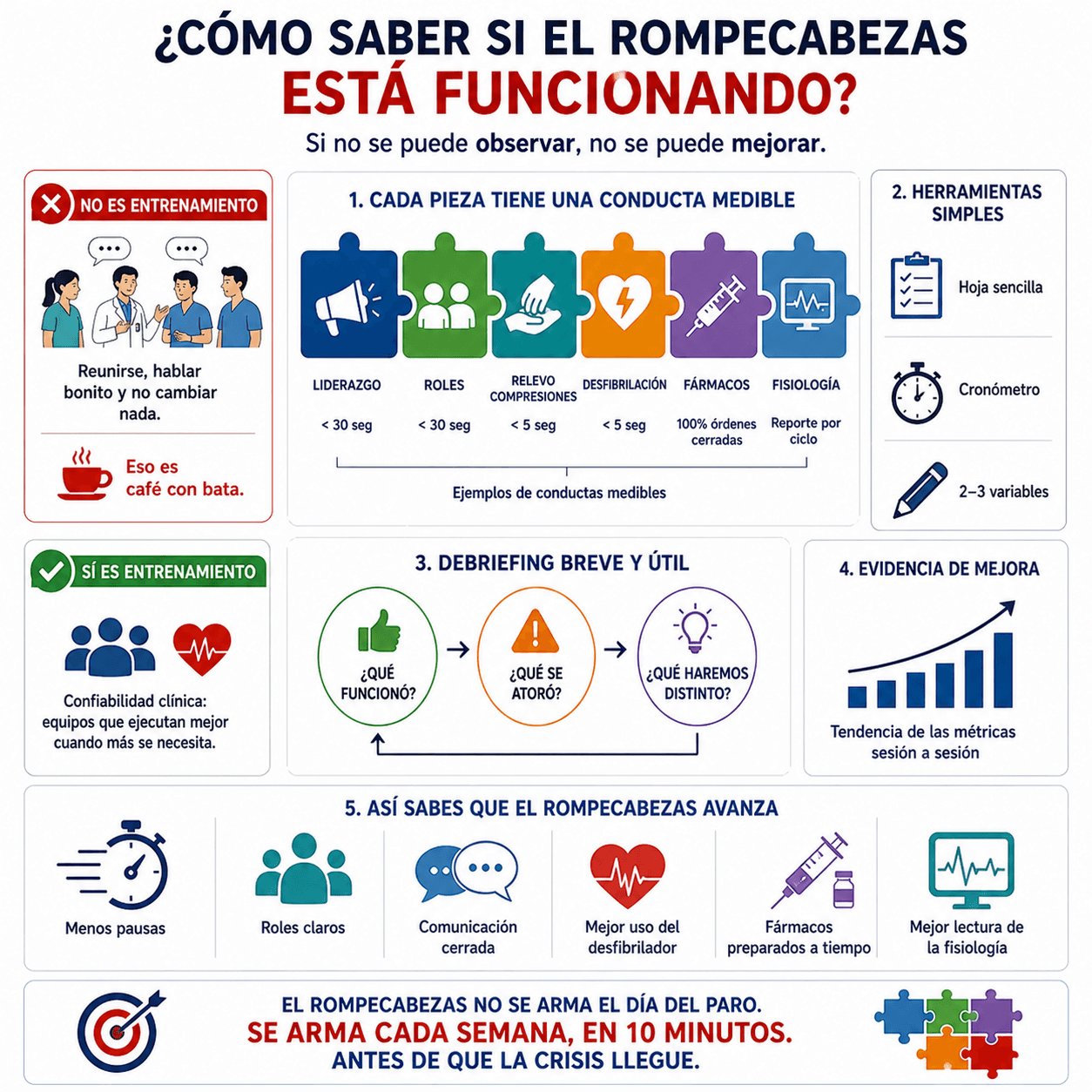
Spanish-language diagram about measurable training within the REASEL Method
Methodological frameworkREASEL MethodUnderstand · Prioritize · Coordinate · Execute · Learn

A pathway for responding

Five connected moves link reasoning to execution.

Open each stage to see the question that organizes the work and the kind of performance it seeks to make visible.

01UnderstandWhat is really happening?

Recognize the clinical problem, context, available information and constraints before carrying out a response.

Reading the scenario and building a shared representation.
02PrioritizeWhat changes the outcome first?

Distinguish what is immediate from what is important, reduce noise and order decisions according to physiology, time and risk.

Cognitive load and decision sequence.
03CoordinateWho needs to do and communicate what?

Distribute roles, confirm messages and integrate information spread across people, monitors and procedures.

Roles, communication and a shared mental model.
04ExecuteIs the intervention producing the expected effect?

Act precisely and with minimal delay, using physiological feedback to correct course when the observed response differs from the expected one.

Observable performance and real-time adjustment.
05LearnWhat should be retained or changed for the next crisis?

Reconstruct what happened, turn the experience into future behavior and sustain learning beyond the course.

Debriefing, traceability and consolidation.

Three foundations

Remember, progress and integrate the team.

The method does not depend on spectacular simulation or a specific technology. It depends on an educational architecture that prepares knowledge, adjusts difficulty and makes the system's work visible.

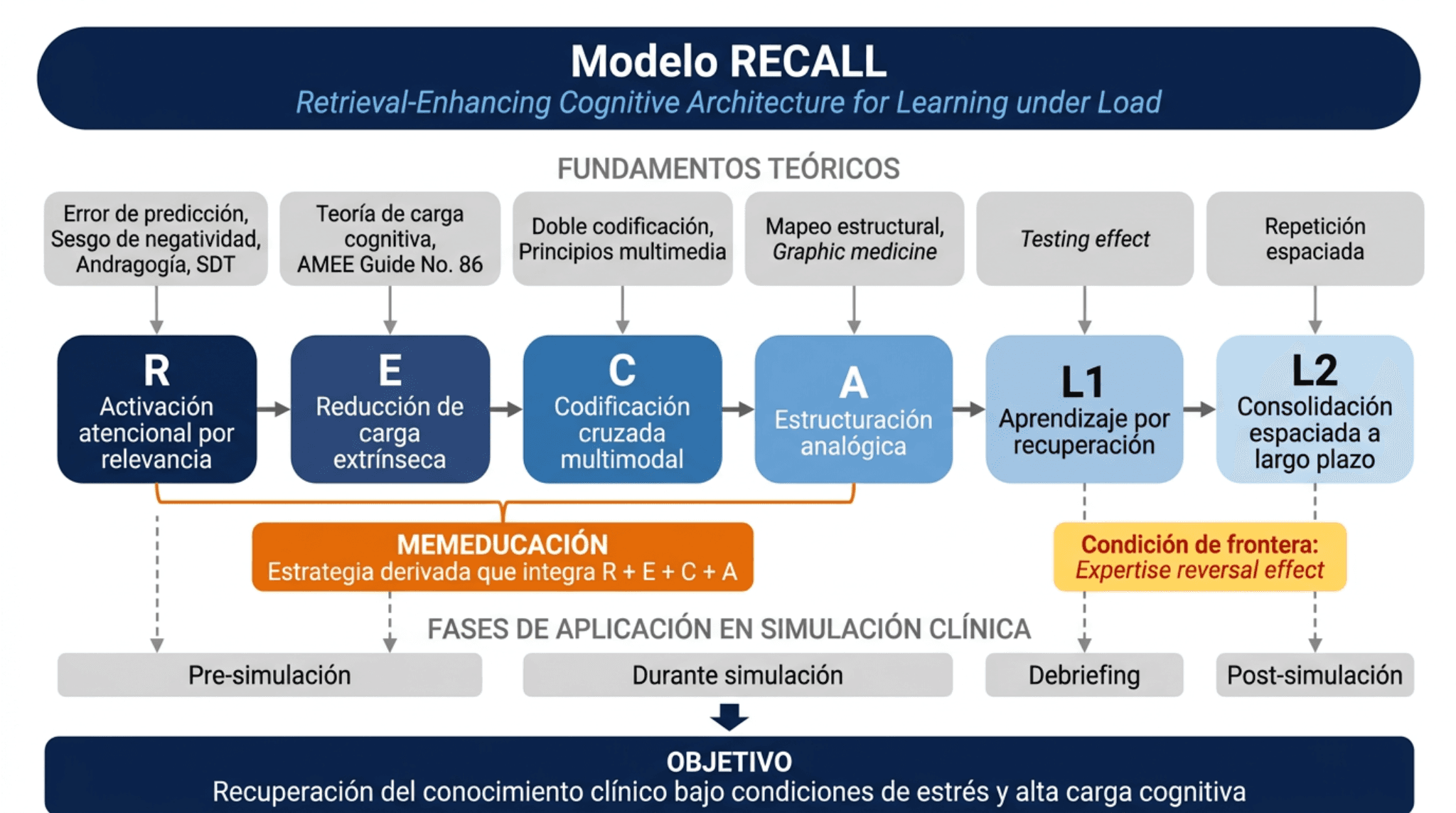
Spanish-language diagram of the public RECALL model architecture
A public architecture designed to prepare knowledge retrieval under load.
Foundation 01

Retrieval under load

The RECALL architecture organizes principles of relevance, reduction of extraneous load, complementary encoding, active retrieval and spaced consolidation.

RECALL is an original REASEL proposal currently subject to validation and academic development.
Foundation 02

Progressive simulation

Skills are isolated, practiced and reintegrated. Complexity increases when performance begins to stabilize, not before.

Technology serves the educational objective; it does not replace design.
Foundation 03

Team learning

Clinical competence is distributed. The team learns to ask, communicate, confirm and integrate information to build a common response.

No one person holds the entire clinical reality.

How a REASEL experience works

First the pieces are prepared. Then they are assembled under pressure.

The experience connects preparation, scenario, observable performance and debriefing. Each part should explain what it seeks, how it is practiced and what evidence helps determine whether learning occurred.

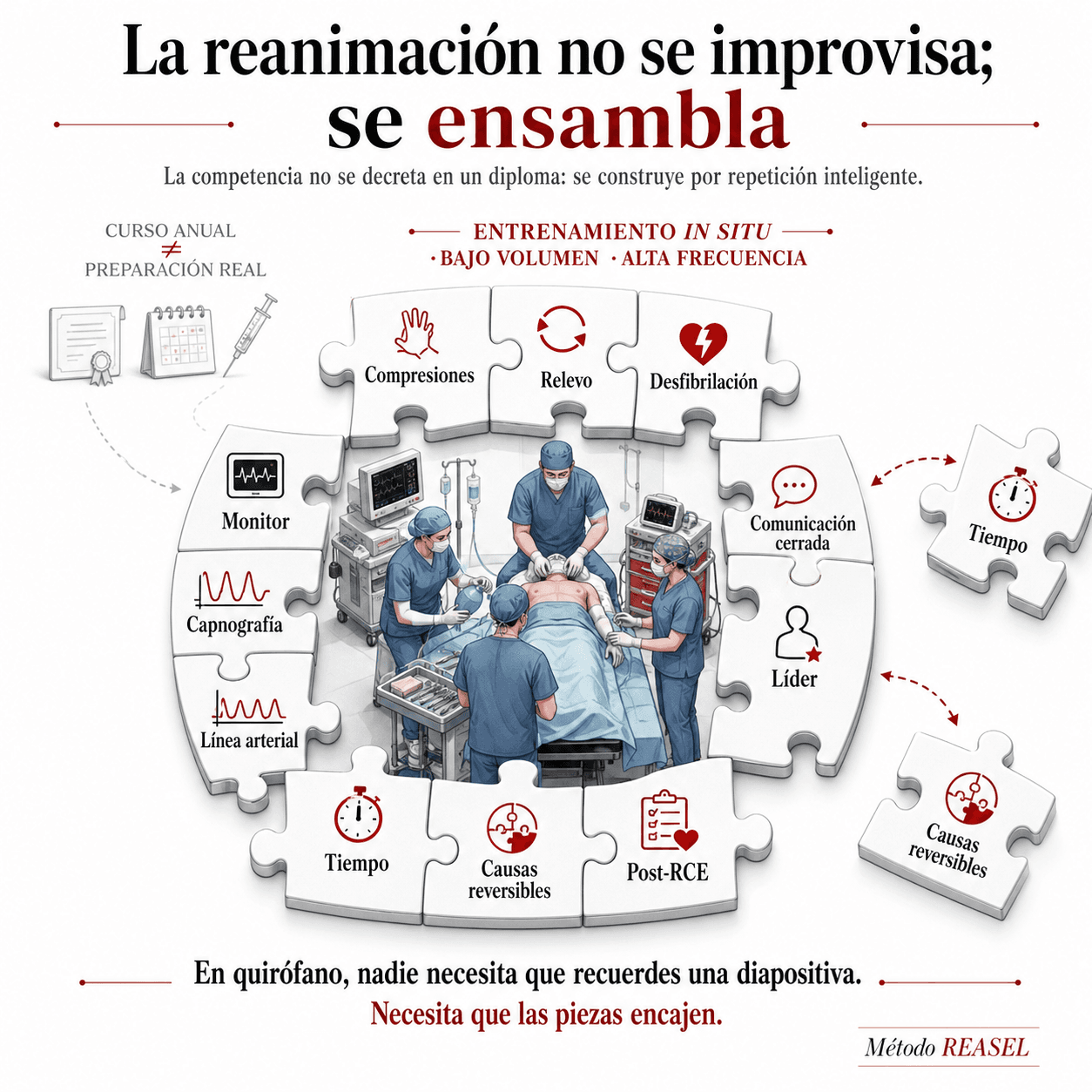
Spanish-language puzzle diagram applying the REASEL Method to resuscitation
01

Preparation

Clear objectives, prior knowledge, proportionate materials and a common framework before entering the scenario.

02

Scenario

Clinical problems designed to reveal decisions, coordination, physiology and observable consequences.

03

Observable performance

Roles, timing, communication and interventions that can be reviewed, corrected and attempted again.

04

Debriefing

Reconstructing events, reasoning and system performance to define a concrete future behavior.

From knowledge to capability

A REASEL experience should be able to explain what it did, why it did it and how it verified learning.

The purpose is not to design perfect people. It is to design learning, teams and systems capable of sustaining a humane, physiology-informed and reproducible clinical response.

Observable decisionsTrainable coordinationTraceable learning
Back to top